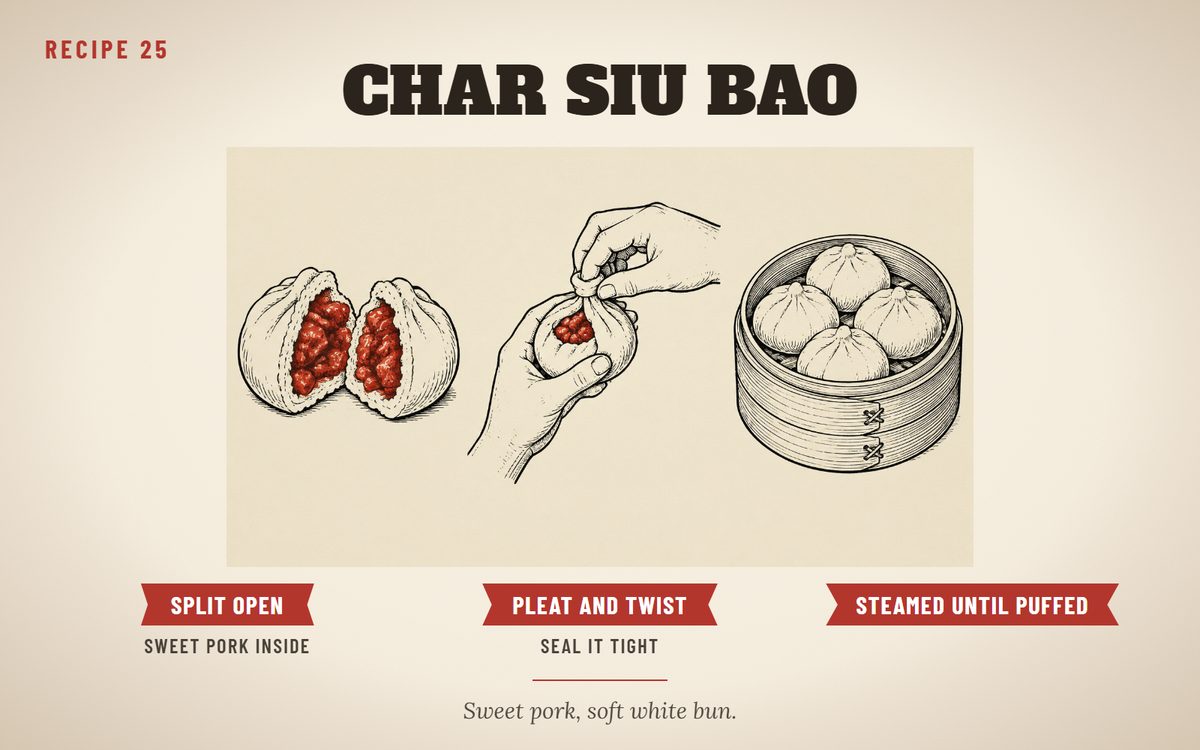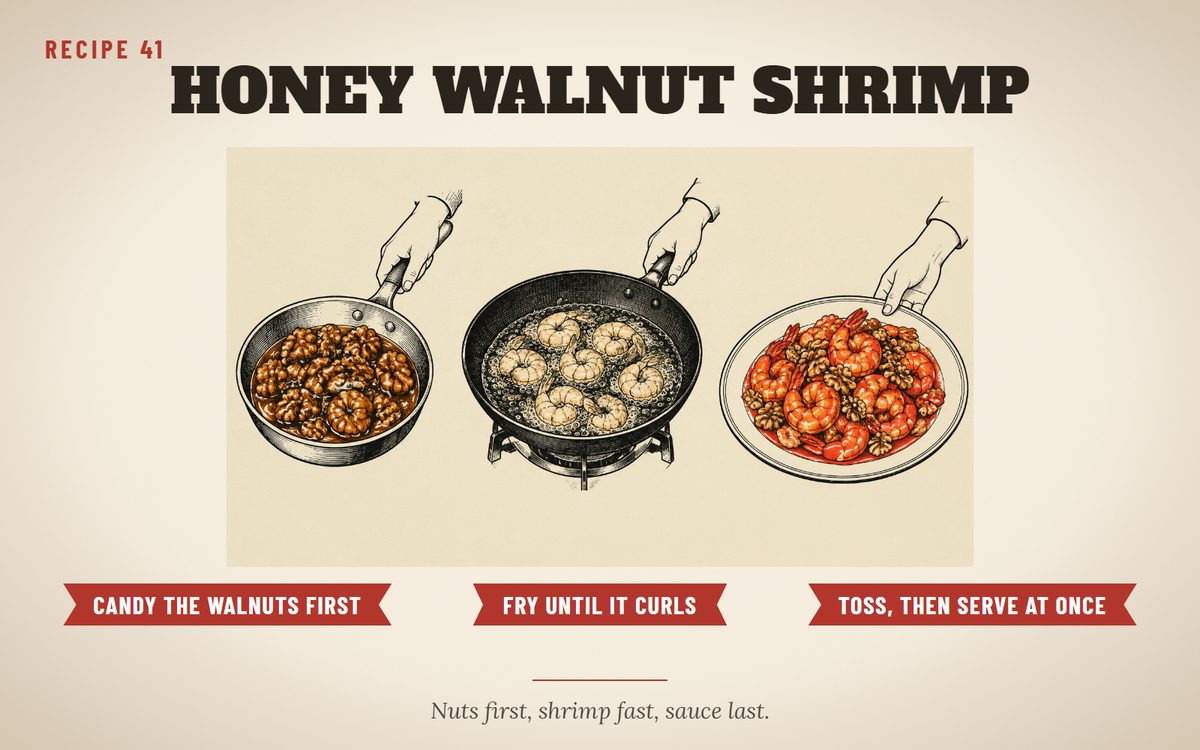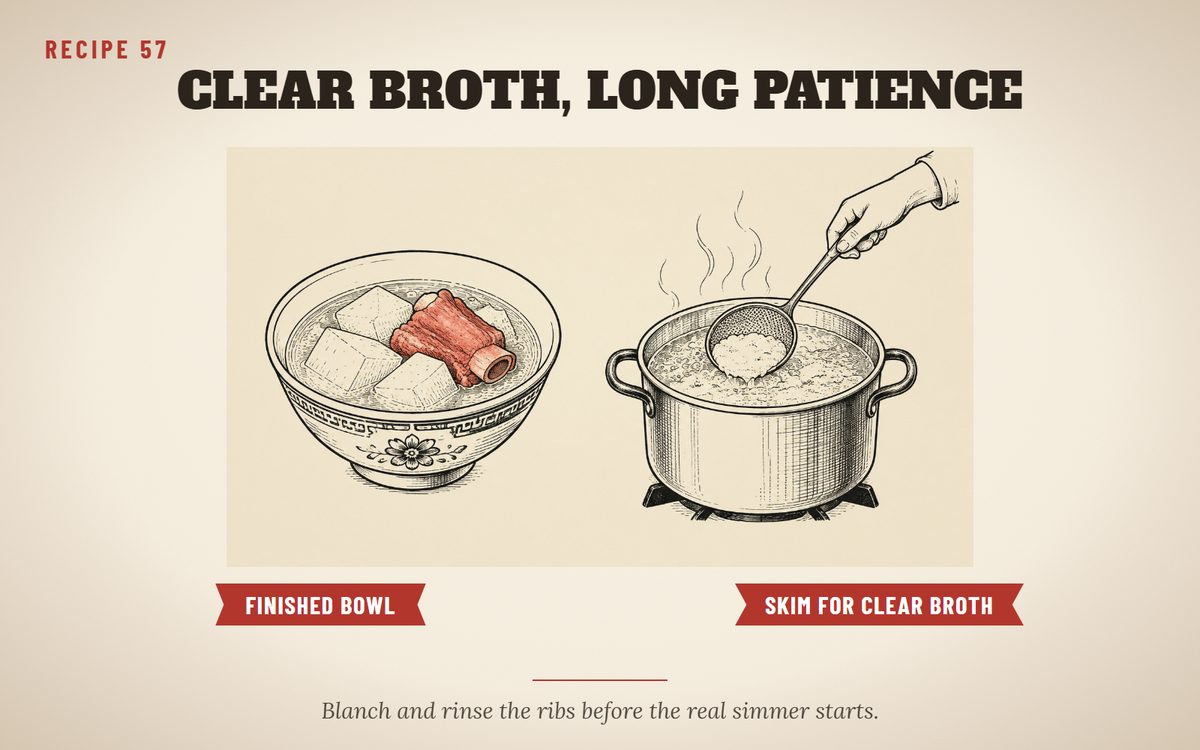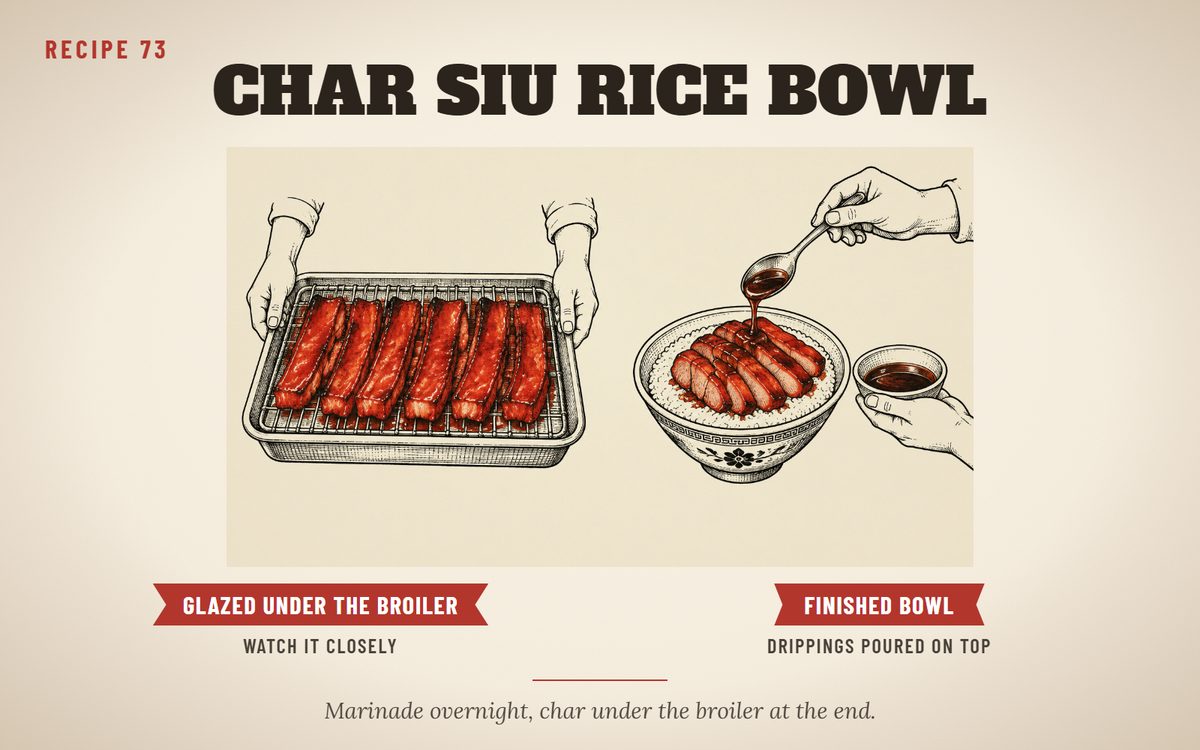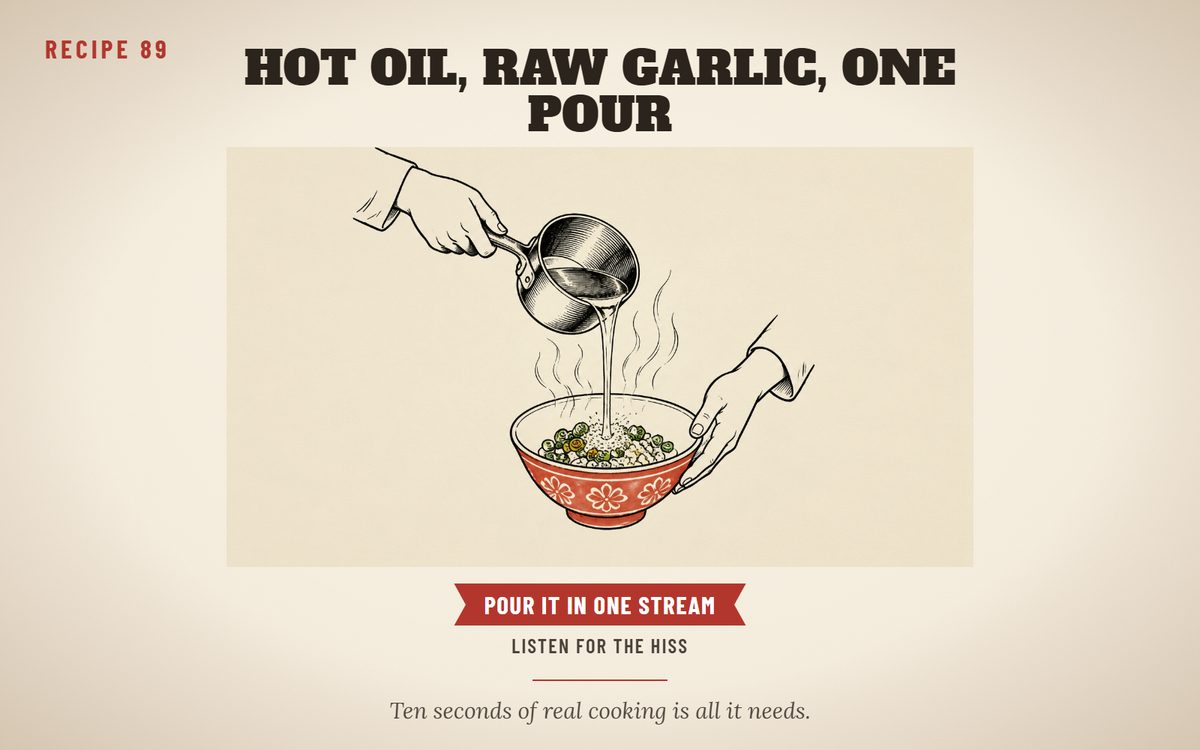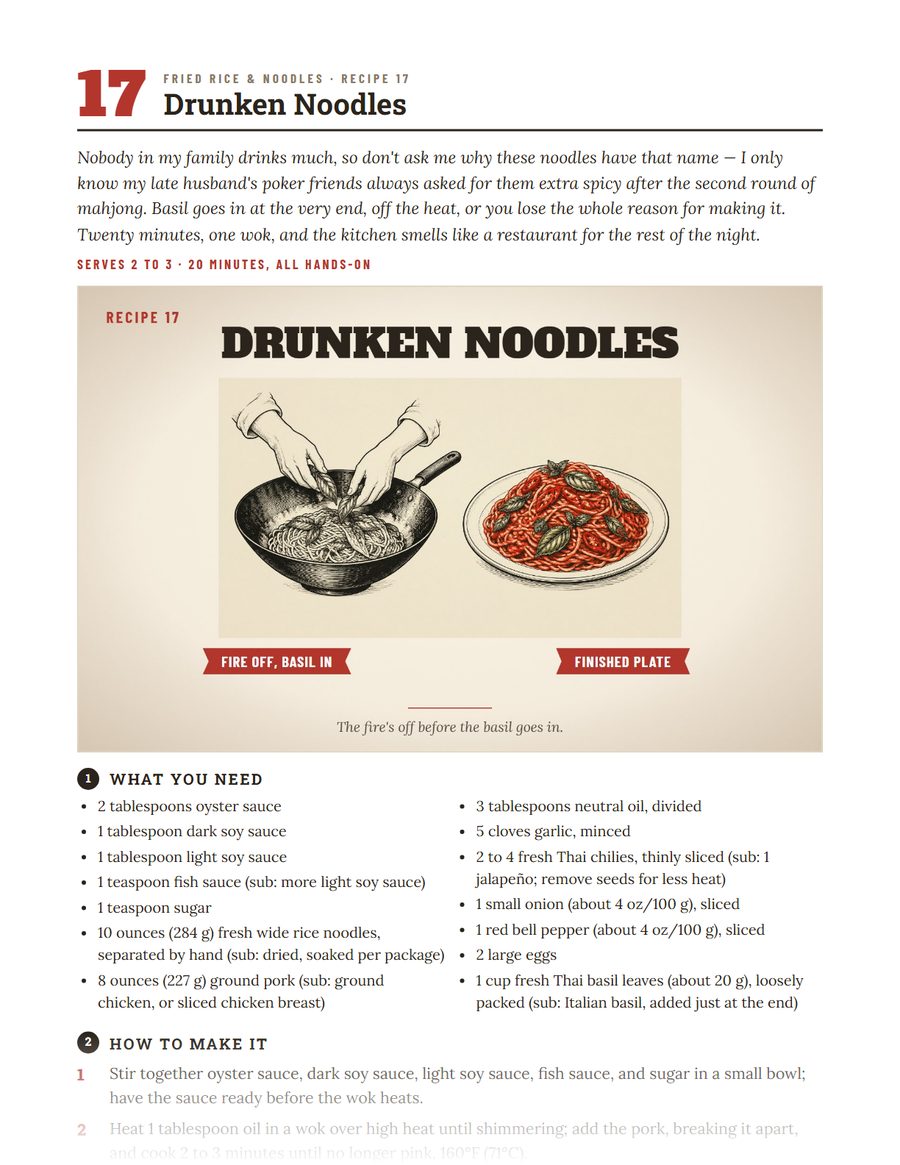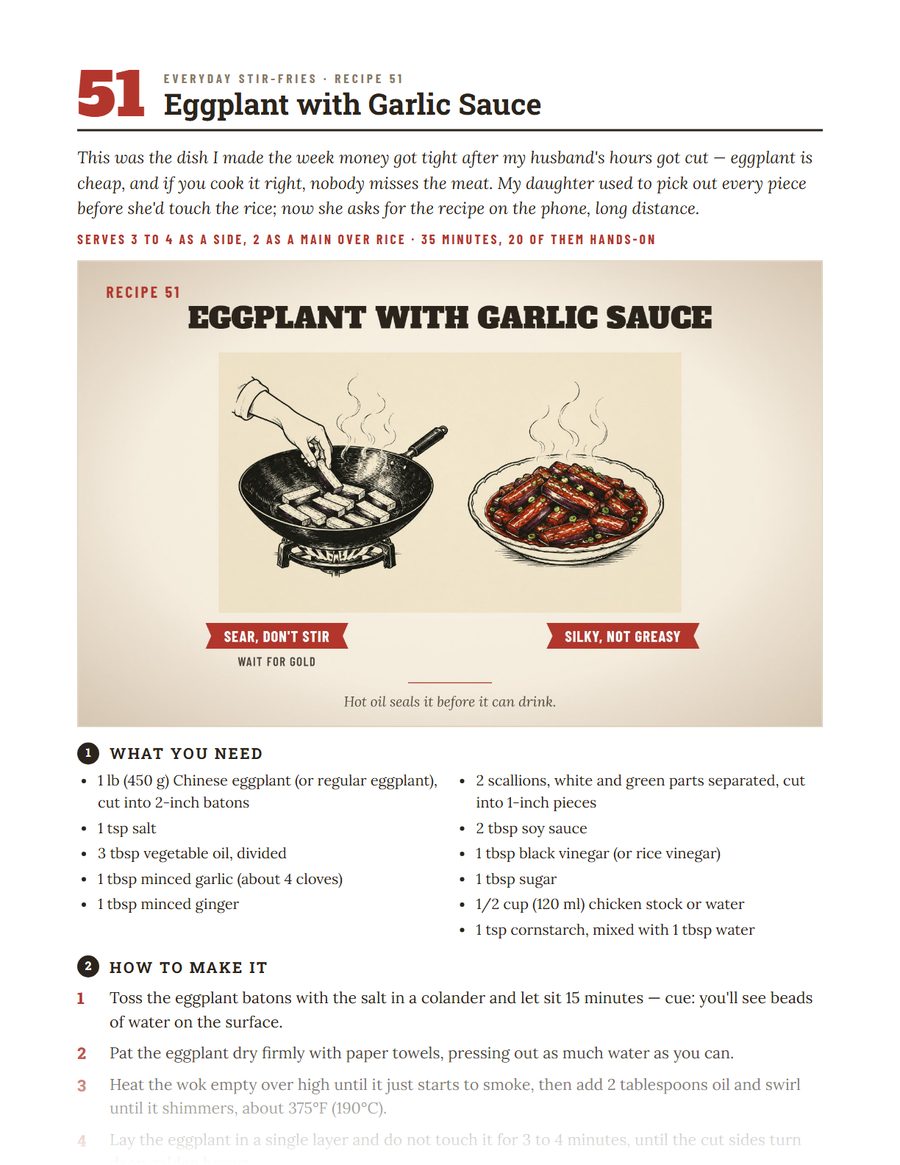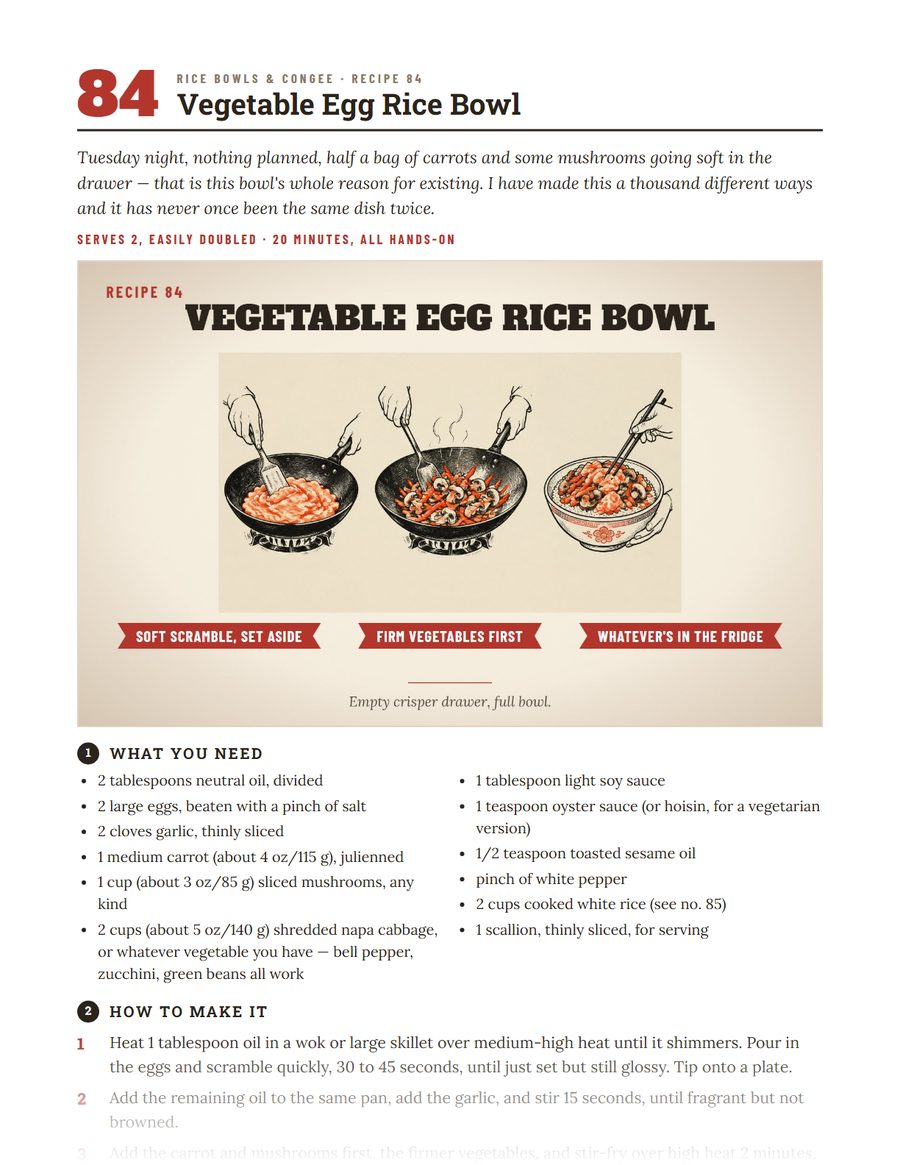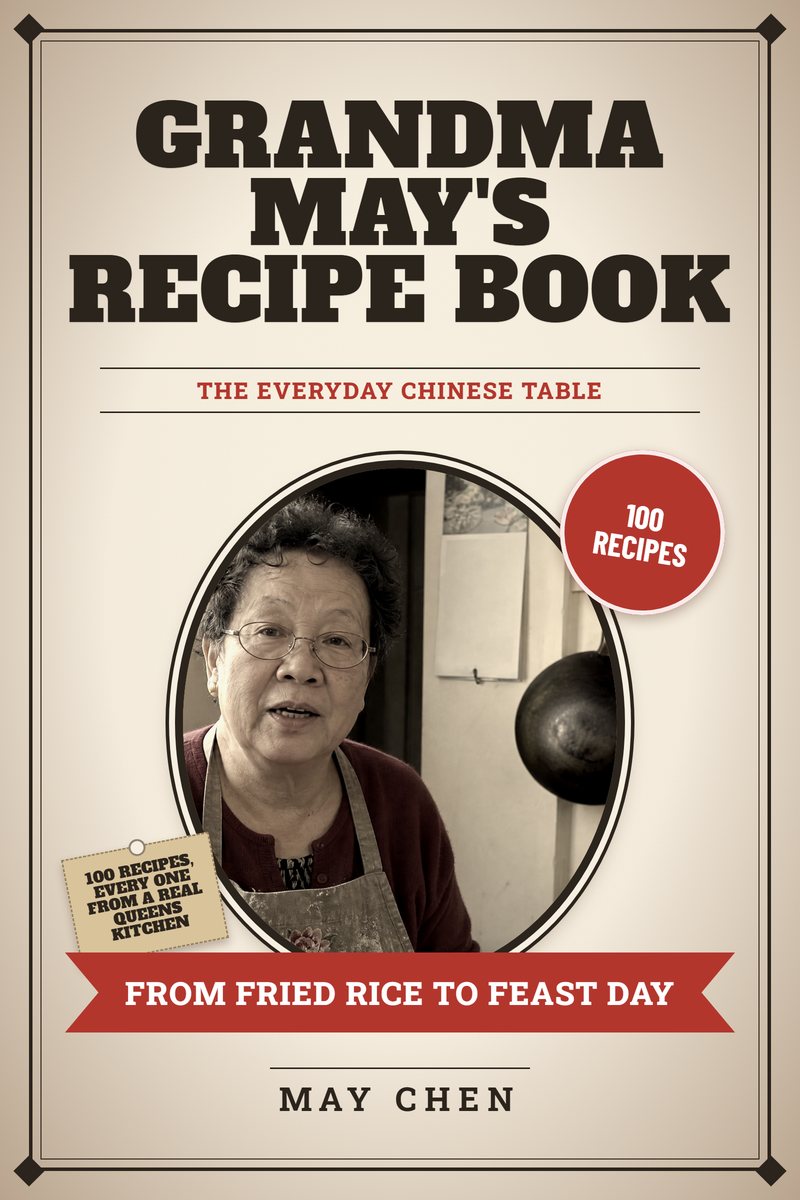
Inside are 100 recipes across six sections — fried rice and noodles, dumplings and buns, everyday stir-fries, one-pot soups, rice bowls and congee, and the pantry sauces that tie it together. Every lesson has a drawing, numbered steps with real times and temperatures, and the common mistakes named with their fix. A 295-entry index at the back lets you look up what went wrong by symptom. None of it needs a special trip to a specialty market.
By buying you agree to the Terms of Sale and Refund Policy.
0 checkouts opened in the last 24 hours
PDF · 354 pages · 100 illustrated recipes · read on phone, tablet or computer, or print it
This is for the Tuesday when payday's still three days off and the fridge has rice, an egg, and whatever vegetable didn't get eaten. It's for standing at the stove at eleven at night making one plate, not hosting a dinner party. The recipes assume a regular grocery store, one wok or skillet, and about twenty minutes.
Flip to the back, find the symptom you're staring at — 'rice came out mushy,' 'basil turned black and bitter' — and it points you straight to the lesson that explains it. 295 problems are indexed that way, by what happened, not by ingredient.
310 named mistakes sit inside the lessons themselves, each paired with exactly what caused it and how to fix it next time, right next to the step where it happens.
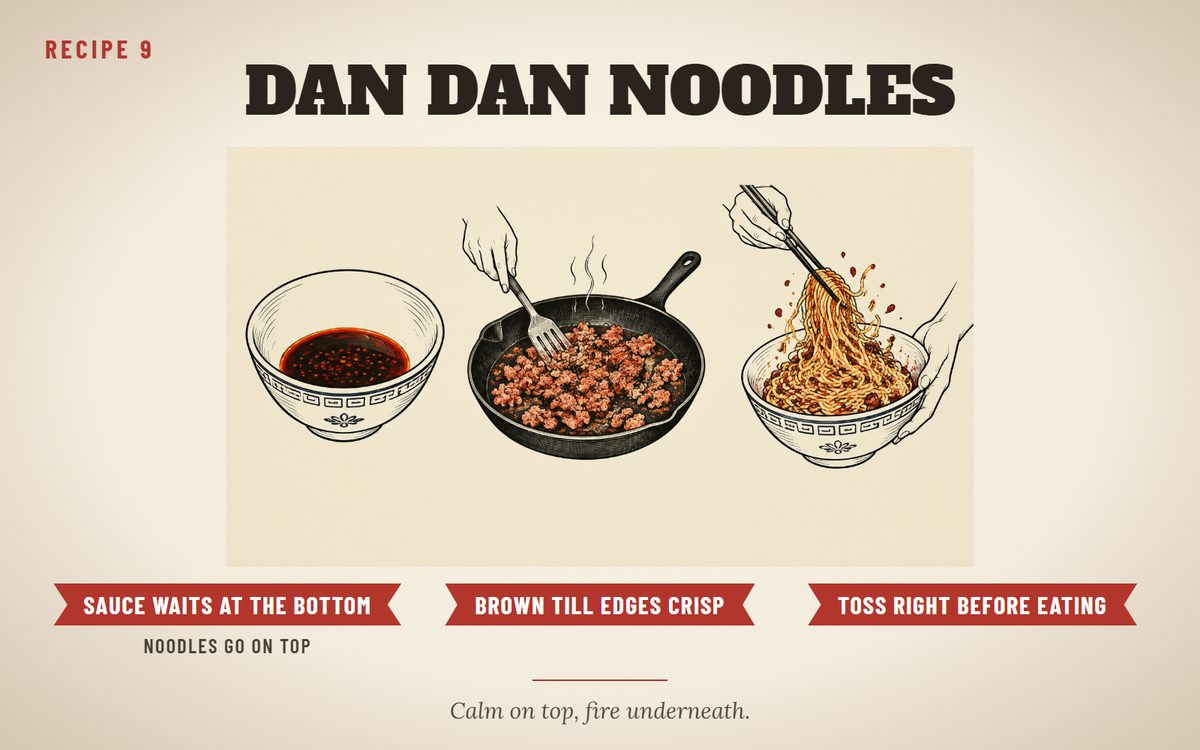
All 100 lessons come with a drawing — what the dish should look like at the point you're deciding whether it's done, not just a finished photo on a plate.
303 numbers run through the reference section — times, temperatures, weights — so 'hot oil' and 'simmer gently' mean something specific instead of a guess.
A typical Chinese takeout dinner for two in a city like New York runs $35 to $45 once delivery and tip are added — call it $38 on an ordinary night. The same beef and broccoli, cooked at home from a regular grocery store, runs closer to $9 to $12 for two plates, mostly the cost of the beef. Seven nights of takeout adds up fast; seven nights cooked from this book adds up to roughly a quarter of that.
These are typical figures from an ordinary grocery store and an ordinary takeout order — yours will vary by store, city, and what's on sale that week.
One volume, six sections, a hundred recipes — fried rice and noodles through dumplings, stir-fries, soups, rice bowls, and the staple sauces that hold the rest of it together.
Each of the 100 lessons includes a drawing of the finished dish at the exact point you're deciding whether it's done.


"Cheap doesn't mean it tastes cheap."
My mother said that to me over the stove in Taishan, when I was still too short to see into the pot.
I left home at twelve for a noodle stall in Hong Kong, and by the time I got to Queens in 1979 I had spent more years cooking for strangers than for my own family.
Twenty-two of those years were at a steam table on Broadway in Elmhurst, portioning out the same dozen dishes to people on their way home from work.
At night I'd go upstairs to our one-bedroom apartment over the hardware store and cook something different for my own three kids — cheaper, plainer, but never thin on flavor.
After my husband passed in 2004, Sunday cooking for the grandchildren became the thing that held the week together.
One of them asked me last year why I never measure anything, and I realized I couldn't answer in a way that would still make sense after I'm gone.
So I started writing it down — the real amounts, the mistakes I've made at that same Formica stove, the ones I still make.
This book is what came out of that, nothing more than what my mother handed down to me, written so it doesn't disappear a second time.
— May

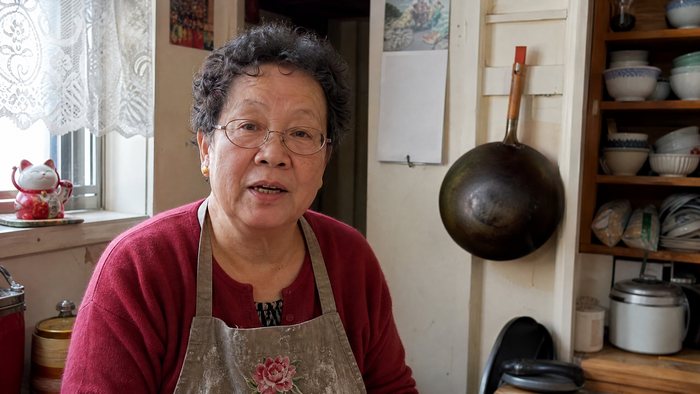
May Chen is the voice of Grandma May's Kitchen — born in 1955 in Taishan, the fourth of six children, who left for a Hong Kong noodle stall at twelve and landed in Elmhurst, Queens in 1979, sponsored by her older brother.
She spent 22 years at the steam table of a takeout counter on Broadway, then went home to a one-bedroom apartment above a hardware store to cook something better for her own three kids. Widowed in 2004, she now cooks for her grandchildren on weekends, in that same Formica kitchen.
We want to say this plainly: May Chen is an AI-generated character. The voice, the kitchen, the biography are fiction. The recipes, the methods, and every number in this book are real, tested, and checked.
“Cheap doesn't mean it tastes cheap — ah girl, write that one down too.”
One digital cookbook — Grandma May's Recipe Book, 100 recipes across six sections, as a PDF, for $27.
The download page opens right after checkout, and the PDF link works straight from that page — nothing to wait for in your inbox.
Yes. It's a PDF, so you can print the whole book or just the one lesson you're cooking from tonight.
No — May Chen is an AI-generated character for the Grandma May's Kitchen channel. The biography is fiction. The recipes, the methods, and the numbers in the book are real and checked.
Yes, standard home-kitchen cooking: safe internal temperatures are given for meat, poultry, and eggs, and the deep-frying lesson covers oil temperature and basic stove safety.
There's a 14-day money-back guarantee. Cook from it, and if it isn't for you, ask for a refund.
Through Stripe checkout — card, Apple Pay, or Google Pay.
Grandma May's Recipe Book is $27, backed by a 14-day money-back guarantee, and ready to open the moment you pay.
By buying you agree to the Terms of Sale and Refund Policy.
0 checkouts opened in the last 24 hours